Design lineage and lore
Black Lotus to Jeweled Lotus: the lineage of 'broken' mana
What changed from 1993 to 2020 — and what design likely does next.

TL;DR: Black Lotus to Jeweled Lotus is 27 years of Wizards learning how to print fast mana that won't break every format. The pattern is clear: each new piece adds a tighter condition. Sol Ring is unconditional. Mana Crypt costs you life. Mox Diamond costs you a land. Jeweled Lotus only fuels your commander. Future fast mana will likely gate on color identity, legendary typing, or archetype-specific synergy — the design space for "just add three mana" closed decades ago.
The Alpha problem
Black Lotus entered Magic in 1993 with Alpha. Zero mana, add three of any color, sacrifice it. No conditions. No drawbacks. It enabled turn-one wins in Vintage and got restricted immediately. Commander banned it outright — the format couldn't function with a card that let one player cast their commander on turn one while everyone else was still playing their first land.
Sol Ring shipped in the same set. One mana, tap for two colorless. Not as explosive as Lotus but nearly as broken. Vintage restricted it. Legacy banned it. Commander kept it legal for one reason: nostalgia. Mark Rosewater has written repeatedly that Sol Ring staying legal in Commander is a cultural choice, not a power-level choice. The format's identity is tied to the card. EDHREC currently lists Sol Ring in 83% of decks — the most-played card that isn't a basic land.
The design lesson from Alpha: unconditional fast mana warps formats. Wizards spent the next 27 years learning how to add conditions.
Mana Crypt and the life-tax experiment
Mana Crypt appeared in 1996 as a book promo for the Mirage novel. Zero mana, tap for two colorless, but at the beginning of your upkeep you flip a coin — lose the flip and take three damage. It's faster than Sol Ring (no mana investment to cast) but the life penalty matters in competitive games where the average combo kill happens around turn four.
Mana Crypt

The condition here is probabilistic. Half the time you take damage. The expected value over ten turns is 15 life lost — substantial in 20-life formats, less punishing in Commander's 40-life structure. Mana Crypt is legal in Commander and sees play in about 15% of decks per current EDHREC data. It's strong but not format-warping. The life tax works.
Design takeaway: a drawback that scales with game length can balance unconditional mana. Crypt proved fast mana could exist if it hurt you.
Mox Diamond and the land-discard gate
Stronghold gave us Mox Diamond in 1998. Zero mana, but you must discard a land as an additional cost to cast it. Then it taps for one mana of any color that a land you control could produce. Two conditions stacked: you need a land in hand to cast it, and the mana it produces is color-gated to your land base.
The land discard matters more than it looks. In the early game you're choosing between playing Mox Diamond or playing that land naturally. In the late game when you're flooded the discard is free — but by then you don't need the acceleration as badly. Mox Diamond self-regulates. It's strongest when drawn in your opening hand alongside multiple lands, which means it competes with your mulligan math.
Mox Diamond
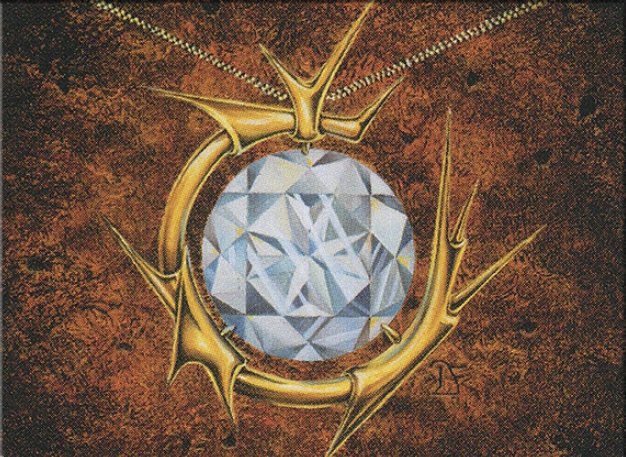
Currently Mox Diamond appears in about 8% of Commander decks. It's priced high (around $400 as of writing) which suppresses play rate, but even in budget-unlimited pods it's not dominant. The land-discard condition works. You can't just drop it and win.
Design takeaway: an additional cost that consumes a resource you'd otherwise use naturally (lands, cards, life) can balance zero-mana artifacts. Mox Diamond proved the cost-gating model.
Jeweled Lotus and the command-zone lock
Commander Legends shipped in 2020 with Jeweled Lotus. Zero mana, sacrifice for three mana of any one color, but the mana can only be spent to cast your commander. This is the tightest condition yet. Black Lotus with a single legal target.
Jeweled Lotus
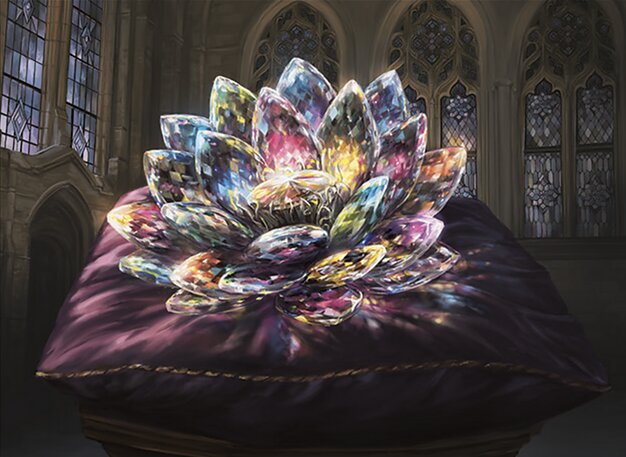
The card generated immediate controversy. Turn-one commanders became common in competitive pods. But the restriction to commander-casting meant Jeweled Lotus was a dead draw late-game if your commander was already in play or if you'd been hit with commander tax repeatedly. It also did nothing in non-commander formats — a first for a Lotus variant. Wizards had figured out how to print a Lotus that worked in exactly one format and only in specific game states.
In September 2024 Wizards banned Jeweled Lotus in Commander anyway. The turn-one acceleration was too swingy. But the design lesson stuck: you can print a Lotus if you lock it to a narrow use case. The card wasn't broken in the Black Lotus sense (unconditional three mana on turn one that works everywhere). It was broken in the format-specific sense (commanders that cost three or four mana got too much value from a free Lotus on turn one).
The banning doesn't invalidate the design pattern. It proves the opposite: Wizards came within one restriction of making a Lotus variant work. The next attempt will just need a tighter gate.
The pattern across 27 years
Laid out chronologically the pattern is obvious:
- Black Lotus (1993): zero mana, three mana of any color, no conditions. Banned everywhere except Vintage where it's restricted to one copy.
- Sol Ring (1993): one mana, two colorless per turn, no conditions. Restricted in Vintage, banned in Legacy, kept legal in Commander for cultural reasons.
- Mana Crypt (1996): zero mana, two colorless per turn, coin-flip life loss. Legal in Commander, sees moderate play.
- Mox Diamond (1998): zero mana, one mana per turn matching your lands, discard a land to cast. Legal in Commander, sees niche play.
- Jeweled Lotus (2020): zero mana, three mana of one color, only for commander casts. Banned in Commander in 2024 after four years of swingy games.

Each step adds a condition. The unconditional versions (Lotus, Sol Ring) are too strong. The life-tax version (Crypt) is borderline. The land-discard version (Diamond) is balanced but narrow. The command-zone-locked version (Jeweled Lotus) was almost balanced but missed by one design tweak.
What comes next
Mark Rosewater has written on Blogatog that the design space for "just add mana" closed years ago. Every new fast-mana piece needs a condition or it breaks something. Based on the last 27 years the likely gates for future fast mana are:
Color-identity locks. A zero-mana artifact that taps for three green mana only, or three mana in your commander's color identity. This keeps the Lotus rate but prevents splashing and limits which commanders benefit.
Legendary-type synergy. An artifact that says "if you control a legendary creature, tap for two colorless" or "if your commander is in play, tap for one mana of any color." This makes the mana conditional on board state, which means it can be disrupted.
Archetype-specific conditions. A zero-mana artifact that says "tap for three colorless. Spend this mana only on artifact spells" or "only on creature spells." This puts the fast mana in a specific deck type and prevents generic goodstuff piles from abusing it.
All three gates follow the Jeweled Lotus model: take the Lotus rate, then lock it to a use case so narrow that it can't warp multiple formats. Wizards learned the lesson. Unconditional fast mana is gone. Conditional fast mana is the only design space left.
The next Lotus will likely cost zero, produce three mana, and have a restriction tighter than "only for your commander." Something like "only for legendary spells" or "only if you control a legendary permanent" or "only in your commander's colors." Each version is testable. Each version is printable. Each version is one small step away from the mistake Jeweled Lotus almost wasn't.
Why this matters for deckbuilding
If future fast mana locks to color identity or legendary typing, then the decks that benefit most will be the ones already built around those constraints. Five-color commanders get weaker if fast mana is color-gated. Legendary-matters decks get stronger if fast mana requires a legend in play.
The Sol Ring era is ending. The next era will be mana that works in your deck specifically, not in every deck generically. That's healthier for format diversity. It's also harder to evaluate during spoiler season — you'll need to ask "does this work in my deck" instead of "is this good."
Watch for the next Lotus variant in a Commander-focused set. It'll have three restrictions stacked. It'll produce three mana. And it'll be printable because Wizards spent 27 years learning how to gate fast mana without killing it entirely.
This is a Commander Pulse evergreen. For weekly EDH data digests delivered to your inbox, sign up here.