Design lineage and lore
The Tergrid problem: a card that's tier-1 at some tables and banned at others
What design choices created the split, and what it means for your pod.

TL;DR: Tergrid, God of Fright reads "whenever an opponent sacrifices a permanent or discards a card, you may put that card onto the battlefield under your control." This means her power level swings wildly based on what the other 99 cards at the table do. Against low-power decks with no forced sacrifice or discard, she's a vanilla 4/5. Against a table running Smallpox or edict effects, she wins in four turns. That split is why she's banned in some pods and ignored in others.
The text that breaks the social contract
Tergrid, God of Fright
Tergrid, God of Fright costs 3BB. She's a 4/5 with menace. Her ability: "Whenever an opponent sacrifices a nontoken permanent or discards a card, you may put that card onto the battlefield under your control. If it's a land, put it onto the battlefield tapped."
No cost. No once-per-turn restriction. No targeting. Just "whenever." The ability triggers on ANY sacrifice or discard from ANY opponent.
This is the core of the problem. Tergrid doesn't generate card advantage by herself. She's a payoff card that requires other cards to enable her. When those enablers are present, she doesn't just gain value. She converts opposing resources into your resources at a 1-to-1 rate, which compounds faster than any other theft effect in the format.
When those enablers aren't present, she's a 5-mana creature with no immediate board impact.
The math of compounding theft
Here's what happens when a Tergrid player lands her on turn 5 and follows with a Smallpox on turn 6:
Smallpox
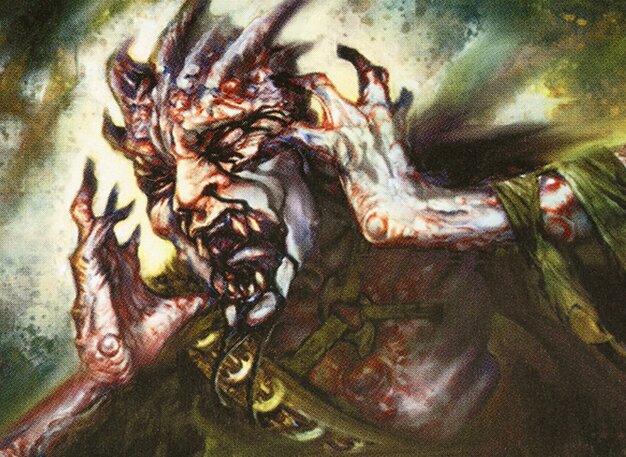
Smallpox reads "each player loses 1 life, discards a card, sacrifices a creature, then sacrifices a land." In a four-player pod, that's three opponents. Each opponent loses one creature and one land. Tergrid's controller gains three creatures and three lands. One card (Smallpox) nets you six permanents.
The Tergrid player now has 10 lands on turn 6. They have three additional creatures. The opponents each have one fewer creature and one fewer land. The Tergrid player is three turns ahead on mana and has a stolen board presence. The game functionally ends here unless someone has an instant-speed answer.
Now compare: same pod, but the three opponents are running creature-based strategies with no sacrifice or discard effects. Tergrid sits on board. She attacks for 4 each turn. By turn 10, she's dealt maybe 12-16 damage to one player. She hasn't generated any card advantage. She hasn't accelerated mana. She's a decent beater in a format where decent beaters don't win games.
The delta between these scenarios is the entire power level of the card. Tergrid doesn't have a fixed bracket. She's bracket-1 when she's oppressive and bracket-4 when she's irrelevant. This is unusual. Most cards have a fairly stable power band. Tergrid's band is four brackets wide.
Why low-power tables can't survive her
Low-power EDH decks run creature removal but not necessarily instant-speed interaction. They run board wipes but not on curve. They run value engines but not redundant ones.
A Tergrid deck at a low-power table can force the issue. The Tergrid player doesn't need a combo. They need to resolve Tergrid and then cast one edict effect. That's it. Most low-power tables can't race that clock. The Tergrid player is now three turns ahead and the table doesn't have the density of answers to catch up.
Here's the specific failure mode: Player A casts Tergrid on turn 5. Player B has no instant-speed removal. Player C has instant-speed removal but is saving it for a bigger threat. Player D just tapped out for a ramp spell. Player A untaps, casts an edict effect, takes three creatures. Now it's too late. Player C uses the removal but the damage is done. The Tergrid player has already converted one card into six permanents and the table is in catch-up mode.
Low-power tables don't have the threat density to punish Tergrid players for tapping out. They don't have the interaction density to answer her before the first payoff. They don't have the fast mana to race her. This is why the Rule 0 conversation happens. The Tergrid player either pulls the deck or the pod dissolves.
Why high-power tables don't care
High-power EDH decks run 8-12 pieces of instant-speed interaction. They run tutors for that interaction. They run fast mana to deploy it on curve. They run low creature counts so edict effects hit fewer valuable targets.
A Tergrid deck at a high-power table faces a different set of constraints. The Tergrid player casts her on turn 5. Player B has Swords to Plowshares and 3 mana up. Tergrid dies. The Tergrid player is now down 5 mana and a card and hasn't generated any value.
Even if Tergrid survives, the payoff is smaller. High-power decks don't run 30 creatures. They run 15-20 and half of those are mana dorks or utility creatures. An edict effect hits a Birds of Paradise or a Sakura-Tribe Elder. Tergrid's controller gets a 1-mana creature. That's not a winning line.
High-power tables also close games faster. Turn 5 is late. If the Tergrid player is spending turn 5 deploying a 5-mana creature with no immediate impact, the combo player at the table is winning on turn 6. The Tergrid player doesn't have time to set up the compound-theft engine.
This is why Tergrid sees almost no play in cEDH and very little play in high-power casual. She's too slow and too vulnerable and the payoff isn't worth the setup cost when the table can answer her or ignore her.
The design choice that created the split
Wizards printed Tergrid in Kaldheim (2021) during a design era focused on scaling effects. The idea was to create cards that got better in multiplayer but weren't oppressive in 1v1. Tergrid's ability triggers once per opponent, so in a four-player pod she triggers three times per effect. In 1v1 she triggers once. The math works.
The problem is that Wizards didn't account for the enabler-dependency curve. Most scaling effects in Commander are linear. Rhystic Study draws one card per spell. Smothering Tithe makes one treasure per draw. Tergrid's scaling is multiplicative. One Smallpox effect with three opponents is six permanents. Two edict effects is twelve permanents. The compounding happens in two turns and the game is over.
Wizards also didn't account for the meta-variance. Most cards perform within a predictable band across different pods. Tergrid performs unpredictably because her power level is determined by the OTHER 297 cards in the pod, not by the 99 in her deck. If the three opponents run no sacrifice or discard, she's dead. If they run any, she's a monster.
This is the design tension. Wizards created a card whose power level is a function of the meta, which means her power level is unknowable until the game starts. That unknowability is what produces the table-banning phenomenon. Players don't want to sit down to a game and find out 20 minutes in that their deck is soft to Tergrid and the game is already over.
What to do if your pod has a Tergrid player
If you're building a deck and your pod has a known Tergrid player, here's the bright line:
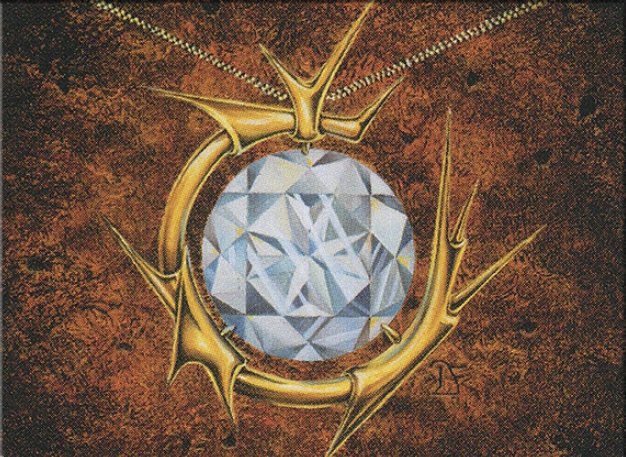
Safe: Cards that discard or sacrifice as a cost. Mox Diamond says "discard a land card" as a cost. That discard doesn't trigger Tergrid because costs are paid before the spell or ability goes on the stack (CR 601.2g). Tergrid's ability triggers on resolution, not on announcement.
Mox Diamond
Other safe examples: Demonic Tutor variants that require discarding as part of the tutor cost. Survival of the Fittest. Bazaar of Baghdad. Anything where the word "cost" appears or the discard/sacrifice happens before a colon.
Dangerous: Cards that discard or sacrifice as an effect. Anything that says "each player sacrifices" or "target player discards" on resolution. These trigger Tergrid. If you're running these effects and there's a Tergrid player at the table, you're enabling them. Cut them or accept that you're feeding the monster.
Specifically dangerous: Edict effects (Diabolic Edict, Geth's Verdict, any card that says "target player sacrifices"). Mass discard (Syphon Mind, Tasigur's Cruelty). Stax pieces that force sacrifices (Smokestack, Braids, Cabal Minion). If your deck runs any of these and there's a Tergrid player in the pod, you're the Tergrid player's best friend.
The other option is to run more instant-speed removal and save it for Tergrid. She's a 5-mana creature with no protection. She dies to everything. If your deck has 8+ pieces of instant-speed interaction and you're holding one up when the Tergrid player hits 5 mana, the problem solves itself.
If your pod doesn't have that interaction density and the Tergrid player won't switch decks, that's a Rule 0 conversation. The alternative is watching the same player win by turn 7 every week until the pod stops playing together.
This is a Commander Pulse evergreen. For weekly EDH data digests delivered to your inbox, sign up here.