Deck construction math
The 36/37/38-land rule, and the cards that break it
Why deck-building wisdom locks in at 37 lands, and the exact cards that let you cheat below that.
TL;DR: Most Commander decks lock in at 37 lands because the math stops rewarding you past that point. But 37 is a guideline, not a rule. Modal double-faced cards, Karoo lands, fetchland loops, and cards that convert artifacts into mana let you run 34-35 lands while playing like you have 38. Here's the math that proves it, and the exact cards that let you cheat.
The 3-land-by-turn-3 problem
Commander games hinge on turns 3 through 5. Miss your third land drop and you're a turn behind. Miss your fourth and you're functionally out of the game until you draw gas. The question every deck builder asks is: how many lands do I need to reliably hit three by turn three?
The answer is hypergeometric distribution. You're drawing 10 cards by turn 3 on the play (7 in opening hand, 3 draw steps). Your deck has 99 cards. You want to see at least 3 lands in those 10 cards.
Here's the formula:
P(X ≥ 3) = 1 - [P(X=0) + P(X=1) + P(X=2)]
Where X is the number of lands drawn. Run the math at different land counts:
- 36 lands: 81.2% chance of 3+ lands by turn 3
- 37 lands: 84.1% chance
- 38 lands: 86.6% chance
- 39 lands: 88.7% chance
- 40 lands: 90.5% chance
The jump from 36 to 37 is 2.9 percentage points. The jump from 37 to 38 is 2.5 points. From 38 to 39 is 2.1 points. From 39 to 40 is 1.8 points.
Diminishing returns kick in at 37. That's where the conventional wisdom comes from. Adding a 38th land costs you a spell slot and only buys you 2.5% more consistency. Adding a 40th land costs you two spell slots for 3.9% total gain over 37. Most players stop at 37 because the trade stops being worth it.
But the curve assumes every card in your deck is either a land or not a land. That assumption breaks the moment you add cards that act like lands without being lands.
Modal double-faced cards: the cleanest cheat
Valakut Awakening // Valakut Stoneforge
Modal double-faced cards (MDFCs) from Zendikar Rising forward have a land face and a spell face. You count them as 0.5 lands when calculating your mana base. A deck with 35 basic lands and 4 MDFCs plays like a 37-land deck on turn 3, but you only gave up 2 spell slots instead of 4.
Run the math again:
- 35 lands + 4 MDFCs (effective 37 lands): 84.1% chance of 3+ lands by turn 3
You get the same consistency as 37 true lands. But in the late game, when you're topdecking, you have 4 cards that can be spells instead of dead land draws. The fail case (drawing the MDFC when you need the land) happens, but the probability is back-loaded. Early game you're happy to see the land side. Late game you're happy to see the spell side.
Currently 12 MDFCs have a land face and see play in Commander. The blue and red ones (Jwari Disruption, Silundi Vision, Valakut Awakening) are the most-played because they're cheap and the spell sides are generically useful. The green ones (Bala Ged Recovery, Tangled Florahedron) slot into ramp decks. The white and black ones are fringe but functional.
Treat each MDFC as 0.5 lands. If you're running 4 MDFCs, you can cut 2 true lands and maintain the same consistency. If you're running 6 MDFCs, cut 3 lands. The formula holds.
Karoo lands: two lands for one card
Azorius Chancery

Karoo lands (the "bounce lands" from original Ravnica) enter tapped and return a land to your hand. They're one card that produces two mana per turn cycle. The return-a-land clause is why they count as more than one land.
A deck with 36 lands and 4 Karoos plays like a 38-land deck after turn 4, because each Karoo is producing two mana. But the math on turn 3 is messier. If you draw a Karoo in your opening 10 cards, it only counts as 1 land for the turn-3 check (because it enters tapped and you had to return a land). So Karoos don't improve your early consistency, they improve your mid-game mana production.
The break-even happens around turn 5. By then you've had time to replay the bounced land and the Karoo is producing two mana per turn. A 36-land deck with 4 Karoos mulligans slightly more often than a 37-land deck, but floods less in the mid-game because each Karoo is doing double duty.
Trade-off: you give up early tempo (the Karoo enters tapped) for late-game mana compression (two mana from one card). Karoos work best in decks that can afford to spend turn 2 or 3 playing a tapped land. Aggressive decks skip them. Ramp decks and control decks love them.
Fetchlands + Crucible of Worlds: infinite lands from a finite count
Crucible of Worlds

Crucible of Worlds lets you play lands from your graveyard. Pair it with fetchlands (Evolving Wilds, Terramorphic Expanse, the ABUR fetchlands if you're not on a budget) and you have a repeatable land drop every turn.
A 36-land deck with 8 fetchlands and Crucible plays like a 40-land deck after turn 6, because you're replaying fetchlands from the graveyard. You never miss a land drop. You also thin your deck (each fetchland pulls a basic out of the library), which increases the density of spells you draw later.
The catch: Crucible costs 3 mana and does nothing the turn it enters. If you draw it on turn 3 you're spending your turn 3 playing it, which means you're not ramping or interacting. The payoff doesn't materialize until turn 5 or 6, after you've cracked a fetchland and started the loop.
Math on this is harder to model because it's conditional on drawing Crucible, but the effect is real. Once the loop is online you stop caring about land count. Your effective land total is "however many turns are left in the game."
Substitute cards that work the same way: Ramunap Excavator, Ancient Greenwarden, Conduit of Worlds (the green enchantment from The Brothers' War that's Crucible with lifegain attached). All three let you play lands from the graveyard. All three turn fetchlands into infinite lands.
Mox Diamond: discard a land to cheat on land count
Mox Diamond
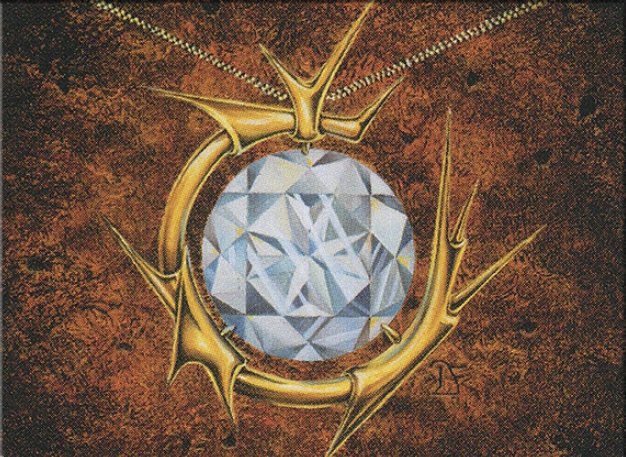
Mox Diamond costs 0 mana and requires you to discard a land when it enters. It produces one mana of any color. The discard clause is why it compresses your land count.
A 36-land deck with Mox Diamond plays like a 37-land deck on turn 1, because the Diamond is producing mana and you only "spent" one land to enable it. The opening-hand math is slightly better than a true 37th land because Diamond produces colored mana (not just generic) and comes down on turn 0 if you're on the play.
The fail case is drawing Diamond without a land to discard. That happens in about 4% of opening hands at 36 lands (you drew Diamond, no land, and 5 spells). Compare that to the 15.9% mulligan rate at 36 lands without Diamond. The Diamond reduces your mulligan rate by about 1.8 percentage points, which is close to the value of adding a 37th true land (2.9 points).
Trade-off: Diamond is expensive (currently around $400 on the secondary market). Chrome Mox is cheaper and does a similar thing (exile a colored card instead of discarding a land), but it doesn't compress your land count the same way. Mox Diamond specifically converts one land in hand into one mana per turn, which is why it counts as +1 effective land.
Tireless Tracker and the artifact-land bridge
Tireless Tracker

Tireless Tracker gives you a Clue token every time a land enters the battlefield under your control. Crack the Clue for 2 mana, draw a card. The Tracker turns every land into "land + card draw," which means you flood less. A 38-land deck with Tracker plays like a 37-land deck in terms of spell density, because the Clues convert excess lands into cards.
This is different from the other effects. Tracker doesn't increase your land count, it increases your spell count by giving you a mana sink for excess lands. But the result is the same: you can run more lands without feeling flooded.
The math works like this: if you draw 2 extra lands in a game (the difference between flooding at 38 lands vs. not flooding at 37), Tracker gives you 2 Clues. Crack those Clues and you've drawn 2 extra spells. Net result: you're back to the spell density of a 37-land deck, but you hit your land drops more consistently.
Substitute cards that create the same mana sink: Ghirapur Orrery (draw cards for having no cards in hand), Sram, Senior Edificer (draw cards when you cast auras or equipment), or any commander with a repeatable activated ability (Kenrith, the Returned King being the cleanest example).
The 34-land deck that plays like 37
Combine the tools:
- 34 true lands
- 4 MDFCs (add 2 effective lands)
- 2 Karoos (add 1 effective land after turn 5)
- Crucible of Worlds + 6 fetchlands (infinite lands after turn 6)
Your opening-hand math looks like 36 lands (34 + 2 from MDFCs). Your mid-game mana production looks like 37 lands (34 + 2 from MDFCs + 1 from Karoos). Your late-game never floods because Crucible is looping fetchlands.
You gave up 3 spell slots (37 traditional lands minus 34 true lands) but you gained back 6 spell slots (the 4 MDFCs and 2 Karoos that can be spells or lands depending on game state). Net: you have more spells in your deck and the same consistency.
This is how competitive Commander decks run 33-35 lands and don't mulligan. They're not cheating the math, they're compressing it. Every MDFC is half a land. Every Karoo is one-and-a-half lands after turn 5. Every fetchland with Crucible is infinite lands after turn 6.
Know your tools and you can build a 34-land deck that plays like 37. Miss your tools and your 36-land deck mulligans 18% of the time. The math doesn't lie, but the math assumes your lands are just lands. Break that assumption and the game opens up.
This is a Commander Pulse evergreen. For weekly EDH data digests delivered to your inbox, sign up here.