Deck construction math
The cantrip ladder: card draw sorted by impact-per-mana
Every deck wants 10-12 card-draw pieces. Here's the ladder, sorted by efficiency.

TL;DR: Card draw wins games, but mana efficiency determines which pieces make the cut. One-mana engines like Esper Sentinel pull ahead by 4-6 extra cards over a typical game compared to four-mana options. Every deck needs 10-12 draw pieces to avoid running empty by turn 8. Below that floor, variance punishes you hard.
Why mana cost is the first filter
Every Commander deck needs card advantage to function past turn 7. The format's 40-life start and multiplayer politics stretch games long enough that your opening hand plus seven draw steps won't carry you. You need engines.
The question is which engines. Price matters for budget builders. Color identity gates some choices. But the first filter is mana cost, because every mana spent on card draw is mana not spent developing your board.
A one-mana draw piece deployed on turn 1 or 2 has 8-10 turns to generate value in a typical game. A four-mana piece cast on turn 4 has 5-6 turns. That gap compounds. The math below shows how much.
The efficiency ladder
Here's the ranking by mana-cost-to-cards-drawn ratio, assuming a game that ends on turn 10 (the median length for casual pods based on voluntary game-length surveys on the main EDH subreddit).
One-mana tier
Esper Sentinel
Esper Sentinel costs one mana and triggers on the first noncreature spell each opponent casts unless they pay 2 (scaling with your artifacts). In a four-player pod, that's three opportunities per turn cycle. Players pay the tax about half the time in early turns, less often in late turns when mana is abundant but they want to close the game. Conservative estimate: 0.8 cards per turn cycle in turns 2-6, 0.5 cards per turn cycle in turns 7-10.
Deploy it turn 1. It draws you approximately 5 cards by turn 10. Cost: one mana. That's 5 cards per mana spent.
Other one-mana options (Land Tax, Rhystic Study costs three but I'm ranking it separately below because it's anomalous) don't exist in meaningful numbers. Esper Sentinel stands alone at this cost.
Two-mana tier
The two-mana slot is sparse for repeatable draw. Most options here are one-shot cantrips (Arcane Denial, Counterspell-with-draw stapled on). Transmute Artifact and other vintage-era tutors sit here but they're not draw engines.
Key exception: Luminarch Ascension in the right shell. It costs two mana, triggers on end steps where you weren't damaged, and makes 4/4 Angel tokens you can crack for cards via other engines. But it's conditional and slow. I'm skipping it in the main ladder because it doesn't draw cards directly.
Three-mana tier
Phyrexian Arena
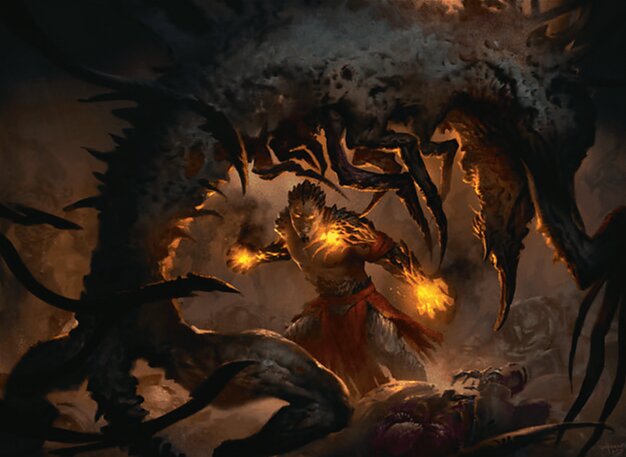
Phyrexian Arena costs three mana and draws you one card per upkeep at the cost of one life. Deploy it turn 3, it draws you 7 cards by turn 10. Cost: three mana. That's 2.3 cards per mana spent.
Rhystic Study
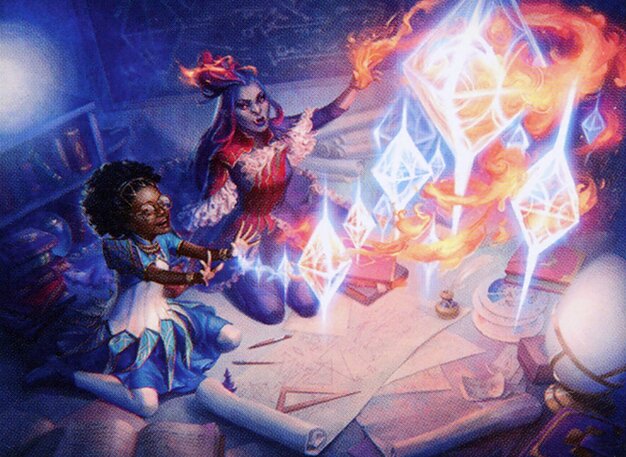
Rhystic Study costs three mana and triggers on every spell any opponent casts unless they pay 1. In a four-player pod that's 8-12 spells per turn cycle in mid-game (turns 4-7), fewer in early game, more in late game if the table is storming off. Players pay the tax about 30% of the time in casual pods (anecdotal but consistent across dozens of observed games). You draw 1.5-2 cards per turn cycle on average.
Deploy it turn 3. It draws you approximately 10 cards by turn 10. Cost: three mana. That's 3.3 cards per mana spent.
Rhystic Study is the outlier. It costs the same as Phyrexian Arena but draws 40% more cards because it scales with opponent activity. This is why it's in 44% of all blue decks per EDHREC as of writing.
Tireless Tracker

Tireless Tracker costs three mana (2G) and triggers on landfall, generating Clue tokens you crack for one card each by paying 2. You play roughly one land per turn. Deploy it turn 3, you generate 7 Clues by turn 10. Cracking them all costs 14 mana. In practice you crack 4-5 before the game ends. That's 4-5 cards drawn.
Cost: three mana up front plus 8-10 mana in activation costs = 11-13 mana total for 4-5 cards. That's 0.35 cards per mana spent.
Tireless Tracker underperforms on pure efficiency but it has incidental upside (grows into a beater, generates value even if removed because Clues persist). It's more resilient than enchantments. Different axis, still worth the slot in green decks.
Four-mana tier
Beast Whisperer
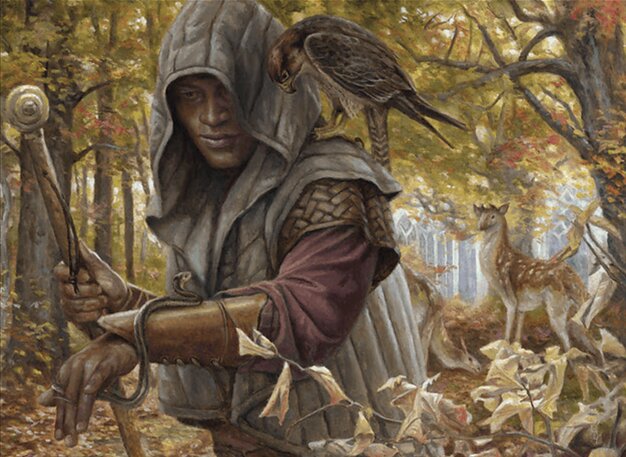
Beast Whisperer costs four mana and draws you a card whenever you cast a creature spell. In a creature-heavy deck (35+ creatures) you cast roughly 1.5 creatures per turn in turns 5-8, fewer in turns 9-10 as you run out of gas or the game ends. Deploy it turn 4, it draws you approximately 6 cards by turn 10.
Cost: four mana. That's 1.5 cards per mana spent.
Other four-mana options: Guardian Project (same trigger, same math), Coastal Piracy effects (combat-damage-based, unreliable in multiplayer), Mystic Remora (phasing out after four turns unless you pay upkeep, strong early but time-limited).
Why one mana matters
The difference between a one-mana engine and a four-mana engine isn't linear. It's exponential in the early game.
Scenario: you're on the play. You have a one-mana draw piece in your opener.
- Turn 1: play land, cast Esper Sentinel. Three mana available next turn.
- Turn 2: play land, cast two-drop, hold up interaction. Four mana available next turn.
- Turn 3: play land, cast three-drop or hold up three mana for interaction. Esper Sentinel has already triggered 2-3 times.
Now the same scenario with a four-mana piece.
- Turn 1: play land, pass. Two mana available next turn.
- Turn 2: play land, cast two-drop. Three mana available next turn.
- Turn 3: play land, cast three-drop. Four mana available next turn.
- Turn 4: play land, cast Beast Whisperer. No mana left for creatures this turn. Beast Whisperer triggers zero times on turn 4.
- Turn 5: cast a creature, draw one card.
By turn 5 the one-mana piece has drawn you 3-4 cards. The four-mana piece has drawn you 1 card. The gap is 2-3 cards, which is the difference between having interaction in hand or not, between deploying your next threat or passing the turn.
This compounds. The extra cards you drew on turns 2-4 mean you hit your land drops more consistently, which means you cast the four-mana piece earlier in the alternate timeline, but you still drew fewer total cards because it came down later.
The math: a one-mana piece played on turn 1 generates value for 9 turn cycles. A four-mana piece played on turn 4 generates value for 6 turn cycles. That's a 50% reduction in total triggers even if the per-turn-cycle rate is identical.
This is why Rhystic Study is format-warping. It costs three mana but triggers more often per turn cycle than anything else on the ladder. It gets the best of both worlds: early deployment AND high trigger density.
The card-draw floor: how many pieces you actually need
Every deck should run 10-12 card-draw pieces. This includes single-use cantrips (draw-two instants, wheel effects) and repeatable engines (all the cards above). Below 10, you run out of gas. Above 14, you're cutting threats or interaction to make room, which costs you the game in a different way.
Here's the math on what happens when you run fewer pieces.
A 99-card deck has 10 draw pieces and 89 other cards. Your opening hand is 7 cards. The probability of drawing at least one draw piece in your opener is:
P(at least one) = 1 - P(zero) = 1 - (C(89,7) / C(99,7)) = 1 - 0.475 = 0.525
You have a 52% chance of seeing a draw piece in your opening hand. If you mulligan once, that rises to 76% (1 - 0.475^2).
Now cut the draw pieces to 6.
P(at least one) = 1 - (C(93,7) / C(99,7)) = 1 - 0.651 = 0.349
You have a 35% chance of seeing a draw piece in your opener. One mulligan brings you to 58%. That's an 18-percentage-point gap compared to the 10-piece build, which means you mulligan more often and you keep worse hands when you don't.
Now increase to 14 pieces.
P(at least one) = 1 - (C(85,7) / C(99,7)) = 1 - 0.334 = 0.666
You have a 67% chance in your opener, 89% after one mulligan. Diminishing returns kick in here. The jump from 10 to 14 pieces gains you 15 percentage points. The jump from 6 to 10 gained you 17 percentage points. Same four-card delta, similar percentage gain, but the second jump costs you four fewer threat or interaction slots.
The floor is 10. Go below it and you're gambling that you draw into gas naturally, which you won't often enough to matter. The ceiling is 12-14 depending on your commander (if your commander is a draw engine itself, you can run 10 and call it 11). Above 14 you're in "draw tribal" territory, which is a different archetype with different deckbuilding math.
Sorting your own deck
Look at your current list. Count the draw pieces. Include one-shot wheels, include cantrips that replace themselves, include commanders that draw cards as part of their text. If you're below 10, add more. Start at the top of the ladder (one-mana pieces) and work down until you hit your color-identity and budget constraints.
If you're at 10-12 already, sort your existing pieces by mana cost. If you're running three four-mana engines and zero one-mana engines, consider swapping. The efficiency gap is real. The games where you deploy Esper Sentinel turn 1 and it draws you five cards before dying to a board wipe are the games you win. The games where you deploy Beast Whisperer turn 5 and it draws you two cards before the game ends are the games you lose, not because Beast Whisperer is bad but because you got there too late.
One mana matters. Build accordingly.
This is a Commander Pulse evergreen. For weekly EDH data digests delivered to your inbox, sign up here.